Launch of the Arctic Pioneer H452
Christened at Cochrane & Sons, Selby, and built for Boyd Line Limited of Hull with modern trawling equipment, wireless installation and fish-liver oil extraction plant.
Research • Archive • Memorial • Education
The life, loss and legacy of the Hull sidewinder trawler Arctic Viking H452 (Boyd Line Limited). Built in 1937 as theArctic Pioneer. Sunk by a German Stuka in 1942. Later salvaged, rebuilt, renamed, and lost in a North Sea gale on 18 October 1961 with five men aboard who never came home. This site also marks the 65th commemoration of the sinking in 2026.
A personal journey
I first heard the name Arctic Viking when I was about 9 years old. My Auntie mentioned it in passing, just a quiet comment that my dad had once survived a sinking at sea and had lost his best friend in the process.
Dad rarely spoke about it. Whenever I asked, he would give the same short answer: the ship sank in heavy seas, he was on the bridge, a big wave hit, and that was that.
Only years later did I learn what he never told us as children: that his closest friend, John, was washed away from the deck as the Arctic Viking rolled. Dad saw him one last time, standing forward on the ship, waving, before the sea took him.
This site brings together the records, newspaper accounts, Ministry of Transport inquiry, crew stories and family memory. It is part research project, part personal journey, part tribute to Hull's deep-sea fleet, and part 65th commemoration of the Arctic Viking's loss on 18 October 1961.
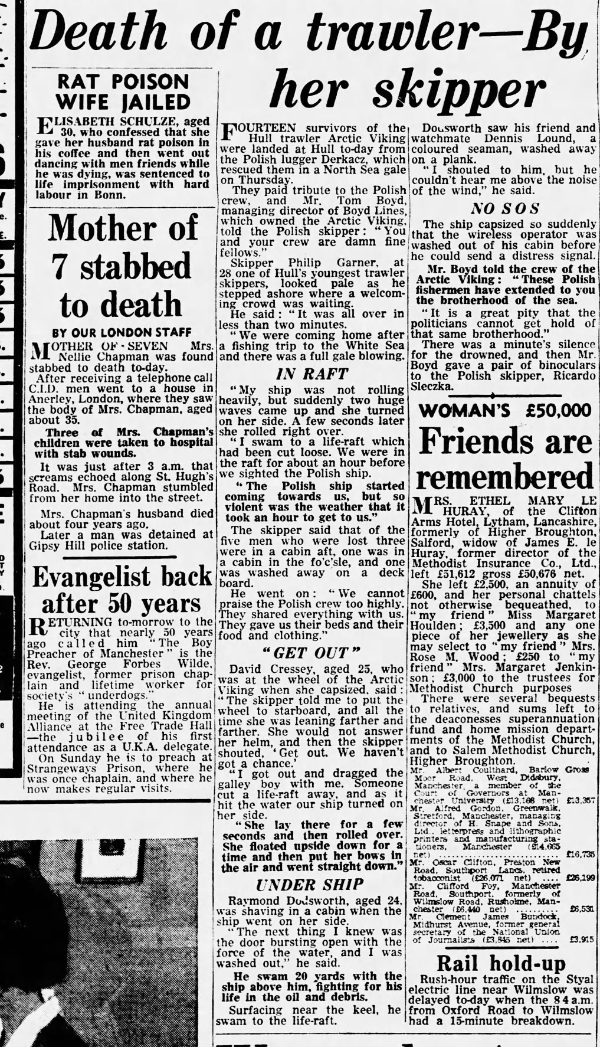
Archive-led storytelling
The website is shaped as a long-form documentary: strong chronology, evidence-led sections, quiet typography, restrained maritime colour and a visual rhythm drawn from newspapers, enquiry records and the ship itself.
The story begins with a son trying to recover what silence left behind, then opens outward into the wider world of Hull fishing families, wartime trawlers, official inquiry and the enduring pull of a wreck beneath the North Sea.
The First Cod War
The Arctic Viking's story was not only one of wartime service and fishing work. On 30 April 1959, during the First Cod War between Britain and Iceland, she was intercepted off south-west Iceland by the Icelandic coastguard vessel Thor while fishing near the disputed 12-mile fishery limit.
According to the parliamentary account recorded in Hansard, Thor pursued the trawler for 1 hour and 40 minutes in an attempt to arrest her. The Arctic Viking's skipper reported that twelve rounds were fired, with the nearest falling close to the bow. HMS Contest, on protection duty in the area, intervened by firing three star shells, after which Thor withdrew.
The incident shows how far Hull's deep-sea fishermen worked from home, and how quickly ordinary fishing could become entangled with diplomacy, naval protection and the wider struggle over North Atlantic fishing rights.
Ship history
Christened at Cochrane & Sons, Selby, and built for Boyd Line Limited of Hull with modern trawling equipment, wireless installation and fish-liver oil extraction plant.
Converted to an armed anti-submarine patrol vessel and assigned to wartime duties, including service connected with the Norwegian campaign.
HMT Arctic Pioneer was sunk by enemy air attack at Cowes Roads in 1942. The exact date she was first raised is not yet documented; notes suggest the wreck was likely cleared earlier because it obstructed harbour access. In 1947 she was restored, re-engined and registered at Hull as Arctic Viking H452.
The ship survived serious post-war incidents, including collision with the St. Celestin near Bear Island and a destructive boiler fire in Hull.
Intercepted by the Icelandic coastguard vessel Thor near the disputed 12-mile fishery limit, Arctic Viking was pursued and fired upon before HMS Contest intervened.
Arctic Viking sailed from Hull for the Norwegian grounds with twenty men aboard. During the outward voyage, third hand J. Kiel was put ashore at Honningsvåg, Norway, after injury.
Homeward bound in a North Sea gale, the ship was struck by two enormous waves, heeled over and capsized. She took barely two minutes to go over.
The surviving crew escaped to an inflatable life raft in mountainous seas. The Polish lugger Derkacz, commanded by Skipper Ryszard Sleska, reached them and brought fourteen men aboard.
Derkacz had to ride out the storm before reaching the Humber. The rescued men and their Polish rescuers returned to Hull to public gratitude and civic recognition.
The formal inquiry at Hull Guildhall examined the loss, crew evidence, ship stability and wave conditions. It concluded that unpredictable wave formations had overcome the vessel in her trim.
Florence Waddy, widow of Bosun Samuel Waddy, brought a damages claim against Boyd Line Limited. The Admiralty Court rejected the claim and found no negligence by the owners or skipper.
Divers reached the Arctic Viking around 20 miles off Flamborough Head in roughly 70 metres of water. The wreck lay on her port side, with the telegraph recovered and the rudder found hard to starboard.
Sixty-five years after the sinking, the Arctic Viking story is placed within the wider memory of Hull's deep-sea fishing industry, its losses, its safety campaigns and its enduring respect for the people who went to sea.
"A coincidence of wave formations of unpredictable and unascertainable proportions..."Ministry of Transport Formal Inquiry into the loss of Arctic Viking H452, 1962
The author's book
On the morning of 18 October 1961, David Cressey was at the wheel of the steam trawler Arctic Viking when two waves in rapid succession put her over in a Force 10 gale off the Yorkshire coast. Five men died. Fourteen survived. David came home and never spoke about it again.
He kept that silence for fifty-six years, through a career as an RAF signals operator and through the founding of a radio club where he listened to the world for decades without once transmitting the thing that mattered most. When he died in 2017, his son Mark began looking for what he had not said.
Hard to Starboard is the account of that search: through newspaper archives and Ministry of Transport inquiry transcripts, through Lloyd's records and the testimony of men who were there, through the family knowledge that the archive cannot hold and the family silences that run three generations deep.
It is the story of a ship that had already survived a German bomb, a collision in the Barents Sea and a boiler fire before the North Sea finally claimed her. And it is the story of what a diver found on the seabed in 2009, forty-eight years after the capsize, twenty miles off Flamborough Head, in seventy metres of water.
The rudder was hard to starboard. Exactly where David said he had put it.
Research archive
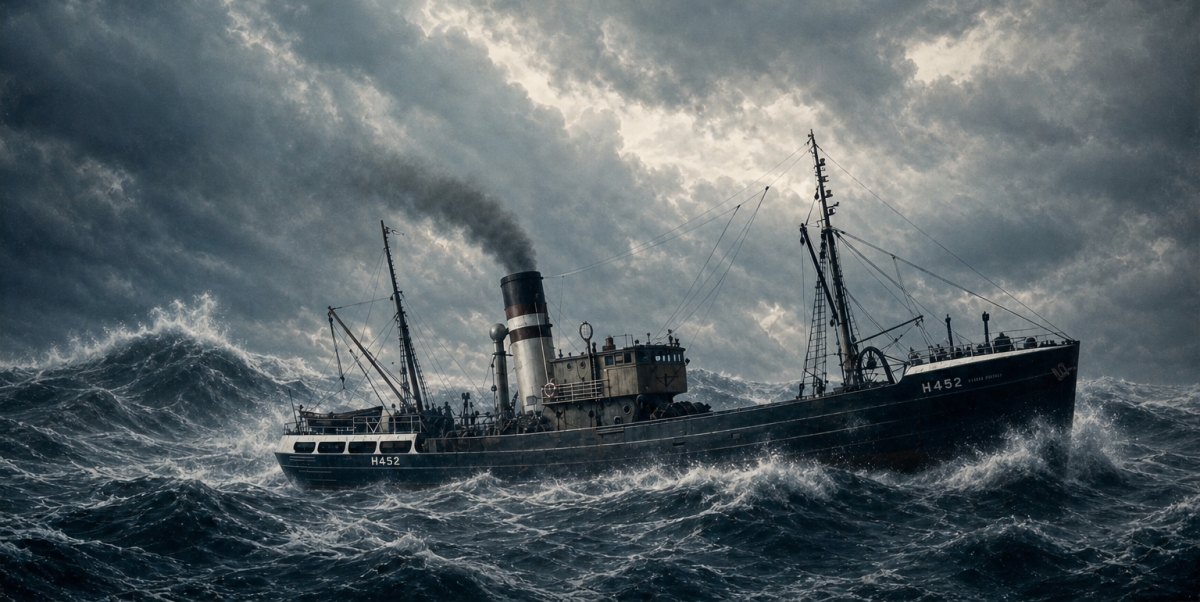
Ship images and working details anchor the visual identity of the site in the trawler herself.
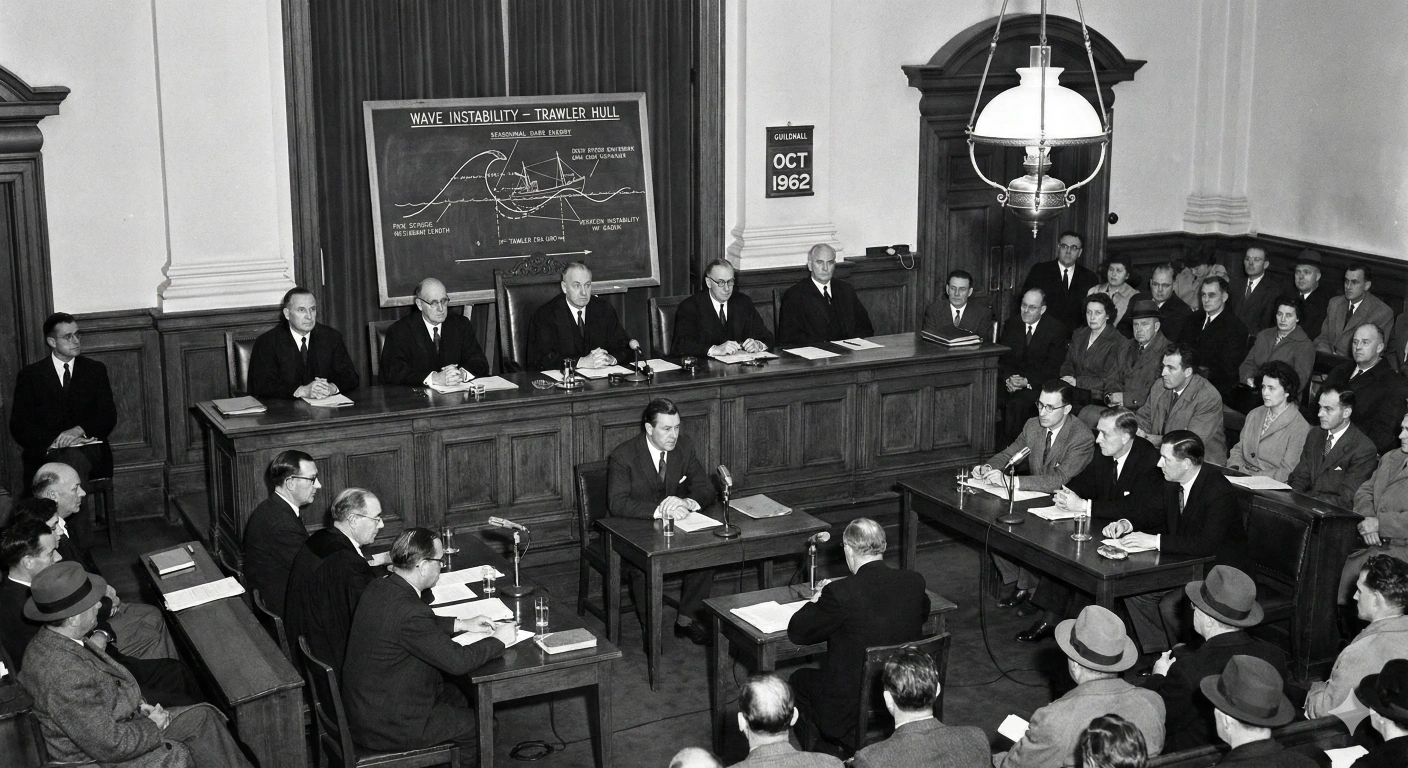
The Ministry of Transport investigation sits at the centre of the technical and legal record.
Newspaper reports preserve how the loss was first told to Hull, Grimsby and the wider public.